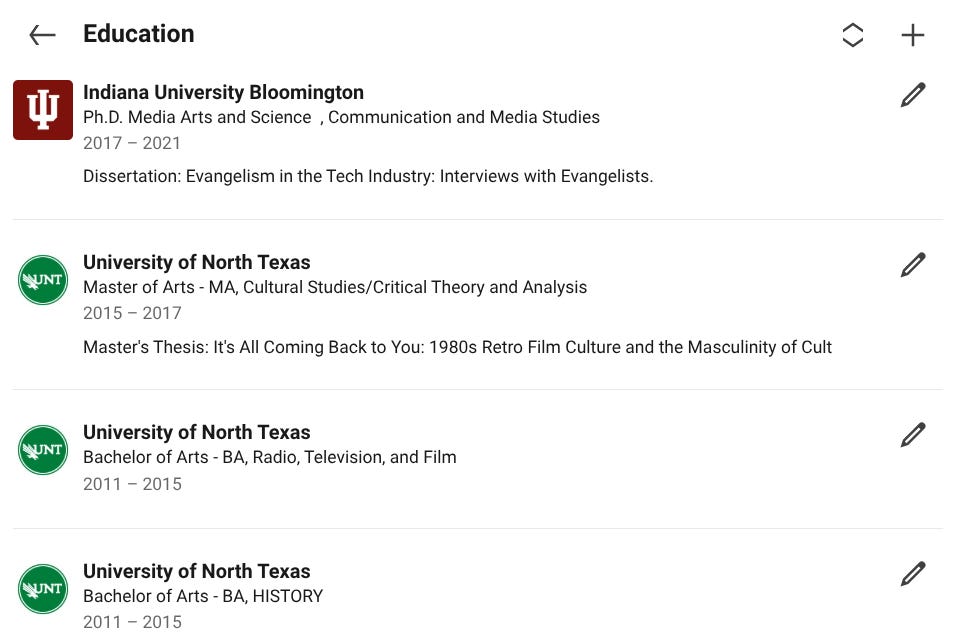
I have two bachelor’s degrees, a master’s degree, and a PhD.
I love learning and I genuinely believe higher education has transformed my life and opened doors but I know deep down that degrees aren’t everything.
If you’re considering another degree because you’re struggling to find a job, feeling stuck in your career, or unsure what comes next, I want you to wait before submitting another application.
Another degree may not solve the problem you’re actually trying to fix.
More education isn’t always the answer
When a job search isn’t going well, it’s easy to conclude that you’re simply underqualified.
Maybe I need another master’s.
Maybe I should get a certificate.
Maybe another degree will make me more competitive.
I’ve heard these thoughts from countless graduate students, postdocs, and PhDs on LinkedIn.
The problem is that employers aren’t always looking for more education. They’re looking for evidence that you can solve their problems. Those aren’t the same thing.
What to do instead of getting another degree
Before enrolling in another degree program, I want to encourage you to try a few things first. None of these options require a multi-year commitment, and each one can help you determine whether another degree is actually necessary.
Talk to people doing the work you want to do
One of the biggest mistakes I see job seekers make is trying to answer career questions on their own. Instead, talk to people who already have the job you want.
Schedule informational interviews with professionals in your target industry. Ask them how they got started, what skills they use every day, what they wish they’d known when making the transition, and what advice they’d give someone in your position.
You may discover that the credential you thought you needed isn’t actually what hiring managers care about. You may also learn about career paths, organizations, or opportunities you didn’t even know existed.
Build experience before collecting another credential
If employers keep telling you they want experience, believe them.
A degree teaches you knowledge. Experience shows employers how you apply that knowledge to solve real problems.
That experience doesn’t always have to come from a full-time job. You can volunteer with a nonprofit, freelance for small businesses, consult within your area of expertise, take on contract work, or start your own project.
Want to move into data analytics? Analyze publicly available datasets and publish your findings.
Interested in science communication? Start writing articles or create educational content.
Thinking about project management? Volunteer to coordinate a community initiative or lead a cross-functional project where you work.
Don’t wait for someone to give you permission to demonstrate your skills. Create opportunities to practice them.
Every project becomes another example you can discuss in an interview, another accomplishment for your résumé, and another piece of evidence that you can do the work.
Invest in your network
Many people assume networking is about asking strangers for jobs.
It’s not. Networking is about building genuine professional relationships over time.
Some of the best opportunities never make it to a job board. They come from conversations, referrals, recommendations, and people who remember you when an opportunity appears.
Reach out to alumni. Attend professional association meetings. Participate in industry webinars. Join online communities. Reconnect with former colleagues, classmates, or collaborators.
The person you meet today may become a mentor, a collaborator, a future colleague, or the hiring manager who thinks of you six months from now.
Relationships compound just like experience does.
Fill specific skill gaps and get feedback
Sometimes additional education really is the right answer.
But there’s a big difference between needing one specific skill and assuming you need another degree. Pay attention to what employers (and recruiters) are actually asking for.
If you consistently see the same software, certification, programming language, or technical competency listed across multiple job postings, that’s valuable information.
Don’t pursue another credential because it feels productive.
Pursue learning that directly addresses a gap between where you are today and where you want to be.
That’s a much better investment of your time, energy, and money.
Ready to build experience?
If you’re looking for a way to gain experience while earning income, I recommend checking out Mercor and Handshake for part-time, contract, and project-based opportunities.
Yes, I know many of Handshake and Mercor’s roles are AI-related. You have to make the decision that’s right for you. But I also know that paying your rent, covering your bills, and staying financially afloat during a career transition matters.
Disclaimer: After Your PhD may receive commission for referrals.

Ryan Collins PhD is an SEO Strategist at Go Fish Digital. Ryan completed his PhD in Media Arts and Sciences at Indiana University Bloomington in 2021. During his time at Indiana University, Ryan eventually pivoted into a career in SEO and Digital Marketing after having informational interviews with working professionals in SEO, working on side projects, and gaining industry experience.